Overview
Article code, season, supplier, target cost, MOQ, and a factory-readiness score that updates as sections complete.
Apparel tech packs
Draw the style, build the BOM, grade the sizes, share one link with the factory, and export a versioned tech pack the sample room can actually sew from.
Try Now opens a read-only demo of a real tech pack. No account needed.
Concept
Between the sketch and the sample there is a spreadsheet, a PDF, a folder of Illustrator files and a chat thread. When one changes and the others don't, the factory sews the wrong thing. Past about ten styles a season, that is the normal state of affairs.
Organization → brands → collections → products. Every section of the tech pack — overview, flats, colorways, BOM, measurements, construction — is a part of one record, not a file that has to be kept in step with the others.
A flat is a set of parameters — silhouette, fit, sleeve, neckline, pocket, cuff, hem — not a picture. Front and back come from the same geometry, a colorway is a fill, and the PDF gets real vectors.
The factory PDF is generated from the record, branded to the brand, and pinned to a version. The sample room is always sewing from the one you sent, never the one that changed this morning.
From concept to factory
Everything it does
Every section a factory expects, in the order a tech pack reads, each with a completion state that rolls up into a readiness score.
Article code, season, supplier, target cost, MOQ, and a factory-readiness score that updates as sections complete.
Parametric front and back flats with named anchors for artwork and callouts, edited on a canvas rather than redrawn.
Named colorways with HEX, Pantone or supplier codes, applied to the flat as a fill rather than a second drawing.
Fabric, rib, trim, thread, label and packaging rows from a reusable material library, with every row's origin recorded.
Placement zone, decoration technique, dimensions and colours for each piece of artwork, with originals preserved.
Points of measure with tolerances, graded across the size range from a base size.
Proto, fit, size-set and pre-production rounds with pinned photo comments and an approval history.
Ordered instructions with seam and stitch types, SPI and tolerances, linked to callouts on the flat.
Main label, care and content, hangtag, polybag and carton instructions that ship with the garment.
Immutable named versions, side-by-side changes by section, and an approval lock on the one the factory is sewing.
What the incumbents charge for
Every plan. Unlimited. A factory guest never counts toward your users.
Organization → brands → collections → products. Libraries and PDF branding belong to the brand, not the account.
A flat is a parameter object, so front and back cannot disagree and the PDF prints sharp at any magnification.
Ten pages, branded, versioned, with repeating table headers and a disclaimer on every page.
Manual, library, import, API or AI draft — and whether a person accepted it. It survives the proposal being closed.
Every screen is also an endpoint. Signed webhooks with retries and a visible delivery log. No competitor under $100/mo has one.
Seed fabric, composition, weight and size chart from the catalog SKU you already decorate.
Suggested BOM rows, construction notes and grading checks, every one reviewed before it touches the spec.
RoadmapRoadmap marks what is in development. Everything else is live in the demo workspace today.
Design
Dark navigation, white working surfaces, one action colour, and enough density to fit a full bill of materials on a 1280-pixel screen.
The sidebar stays out of the way, the surface stays white, and the only colour that asks for a click is cobalt. Compact by default, because a BOM is a table.
A flat is a parameter object — silhouette, fit, sleeve, neckline, pocket, cuff, hem. Front and back cannot disagree, a colorway is a fill, and the factory PDF prints real vectors at any magnification.
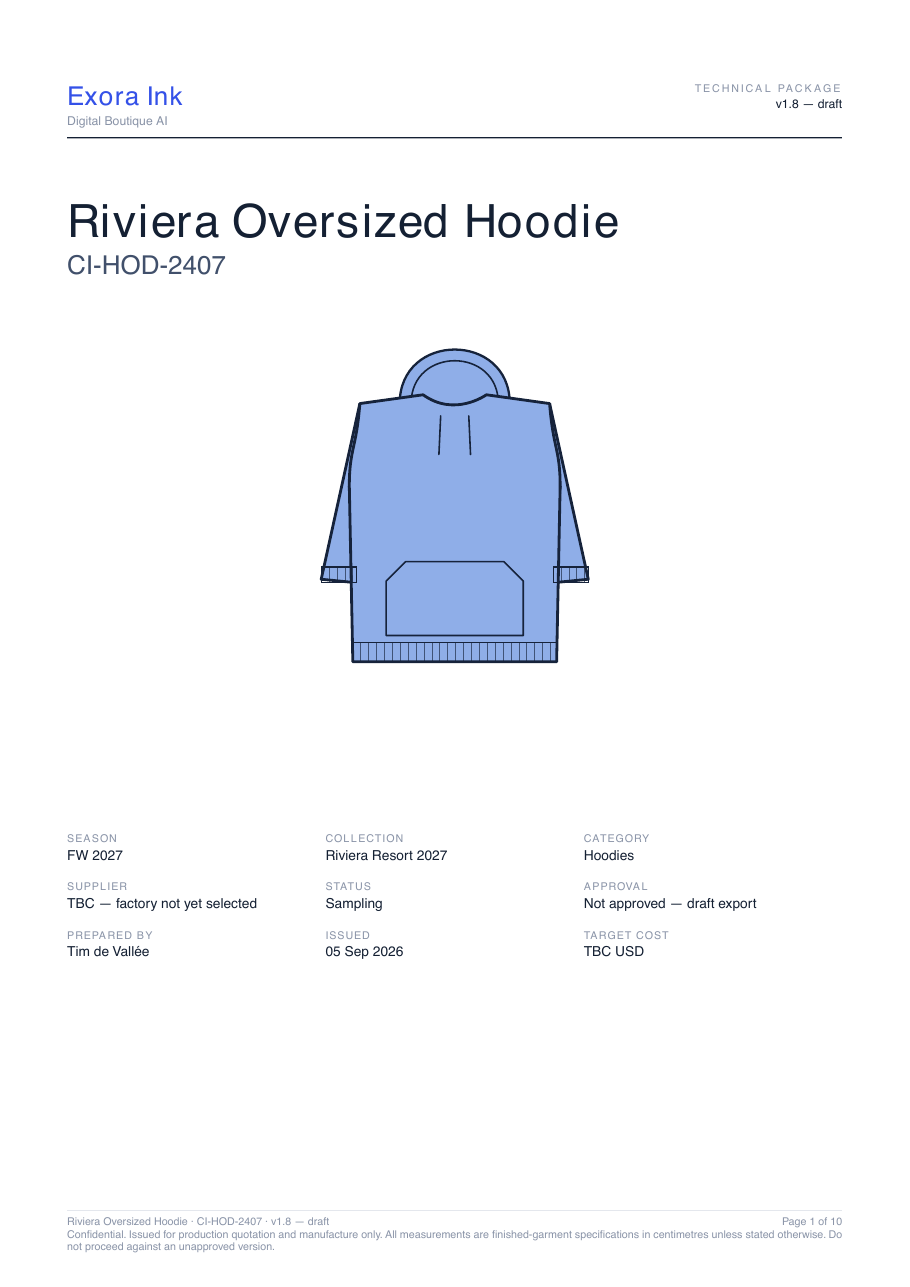
Branded to the brand, pinned to a version, with repeating table headers and a disclaimer on every page.
Who it's for
Take the blank you decorate today and turn it into a cut-and-sew style with the fit your customers already buy. Start from the catalogue SKU you already stock Roadmap, then change what you want changed.
Flats, BOM, and graded measurements without an Illustrator licence or a spreadsheet template.
Libraries and PDF branding belong to the brand, so two labels under one company never share a fabric list.
A measurement that changes updates the table the factory reads, not a copy of it.
Open the version you were sent, comment on it, and acknowledge it — no seat, no account, no charge to the brand.